Blog Post
Published - Apr 29, 2026
How AI Is Changing Jobs in 2026
Artificial Intelligence is reshaping how people discover opportunities, apply for roles, and build careers across industries.
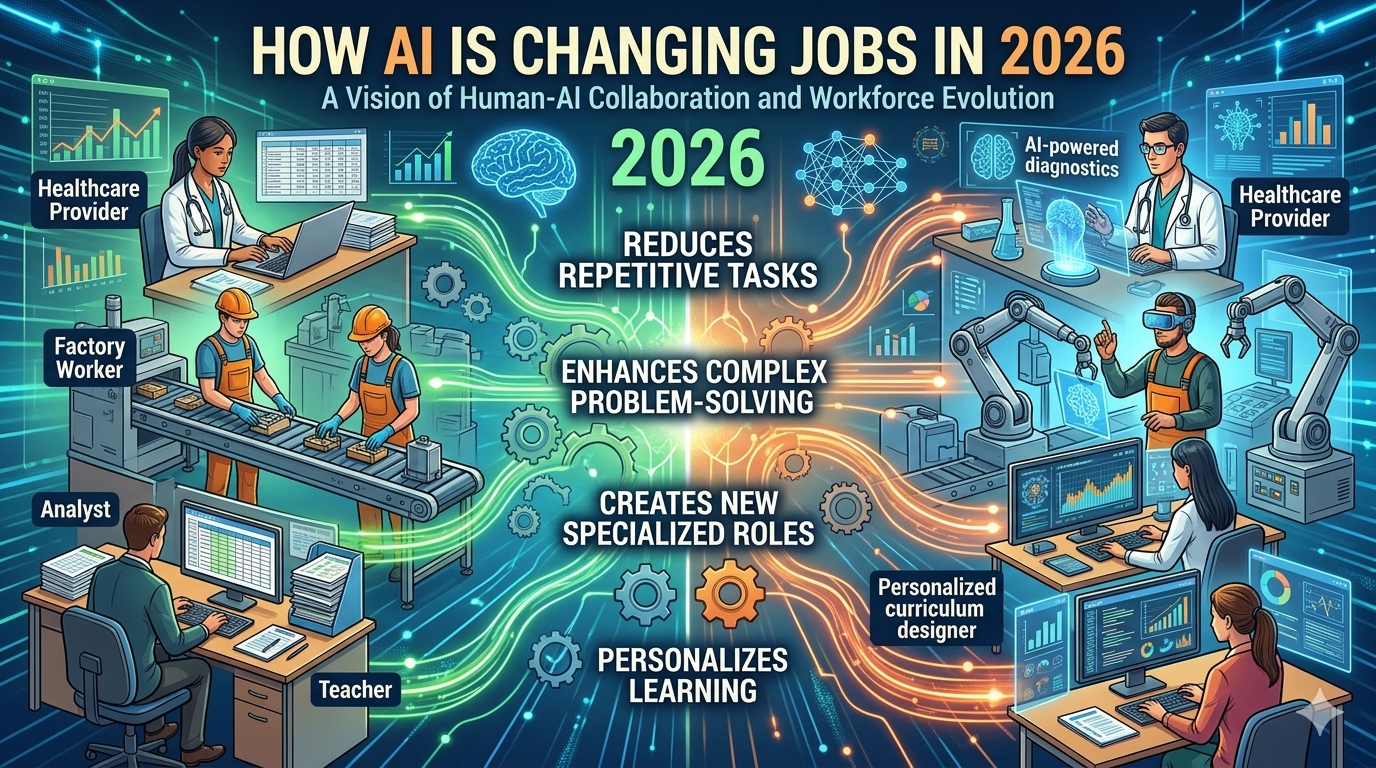
AI is changing jobs in 2026 in ways that feel both practical and personal. It is shaping how people discover roles, how recruiters review applications, and how daily work gets done after someone is hired. The biggest impact is not a single dramatic replacement story. It is the steady spread of tools that automate repetitive tasks, assist decision-making, and raise expectations for digital skills across almost every industry.
That shift affects both employers and job seekers. Recruiters use AI to screen applications, summarize candidate data, and identify patterns faster. Workers use AI to draft emails, organize research, analyze spreadsheets, and prepare for interviews. People trying to understand the employer side of that story can pair this article with AI in business trends and use cases.
How Work Is Changing Day to Day
Many roles are becoming more AI-assisted rather than fully automated. Customer support agents use AI to draft responses, marketers use it for research and content ideas, and analysts use it to summarize large datasets faster. The advantage is speed, but the requirement is judgment. Workers who know how to review AI output, catch mistakes, and improve prompts are becoming more valuable across teams.
Remote and hybrid work also fit naturally with AI adoption. Teams rely on AI for note-taking, scheduling support, knowledge search, and progress summaries. That makes collaboration smoother, but it also raises questions about privacy, monitoring, and trust. Those concerns are part of the broader picture in challenges and limitations of AI.
Skills That Matter More in 2026
- Prompting and tool fluency for common workplace tasks.
- Critical thinking and fact-checking when AI-generated output is involved.
- Communication skills for editing, clarifying, and presenting AI-assisted work.
- Security awareness, especially when handling shared accounts or sensitive data.
Security awareness is becoming especially important because more work happens across cloud tools, shared dashboards, and login-based platforms. Job seekers and professionals alike benefit from stronger credential habits, which is why how to create an unhackable password in 3 seconds is relevant even in a careers discussion.
What This Means for Job Seekers
People who adapt early have a clear advantage. That does not mean becoming an AI engineer. It means learning how AI fits into your field, how to use it responsibly, and how to show employers that you can combine efficiency with accuracy. AI is not just changing the jobs available. It is changing what “job-ready†looks like.