Blog Post
Published - May 02, 2026
Challenges and Limitations of AI
Free AI tools can help students, creators, and educators build helpful resources quickly, but strong results depend on how you handle accuracy, privacy, bias, and trust.
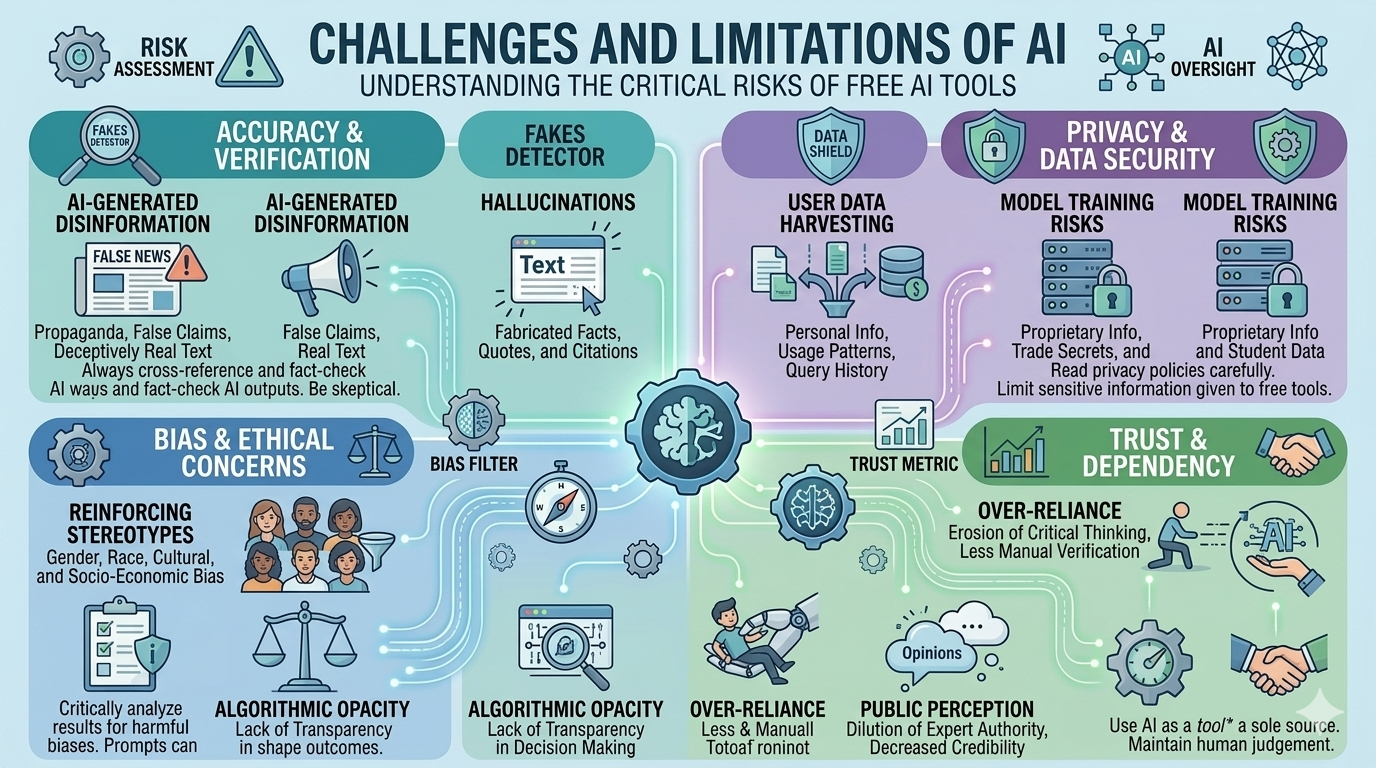
Anyone with a simple idea can now turn it into a working online utility. A student can make a study planner, a teacher can build a rubric helper, and a small website owner can publish a title generator or checklist without hiring a full team. That is why free AI tools are getting so much attention. They reduce setup time, speed up writing and coding, and make it easier to launch pages that solve real problems. At the same time, the challenges and limitations of AI still matter. If you want your tool to be useful, searchable, and trusted, you need to understand both the opportunity and the risk.
Search behavior already shows this demand. People look for Artificial intelligence articles for students, Best articles on artificial intelligence, and even Artificial intelligence articles for students 2026 when they want quick research support. A free AI-powered reading organizer, citation helper, quiz generator, or glossary tool can serve that audience well, especially when paired with clear explanations like the ones in our AI in education news and developments. If you want a more practical example of publishing with care, our guide to creating free tools with AI shows how useful resources can be built around real user needs.
Why AI Makes Free Tools Easier to Build
AI can help you brainstorm a tool idea, outline the page, write interface copy, generate starter code, and improve the user flow. For education-focused tools, it can also help personalize learning, give users immediate feedback, and expand greater access to resources. For example, a tool that summarizes classroom reading or converts notes into quiz cards can support students who need faster revision cycles. Another tool might provide text simplification, captioning, or text-to-speech features that contribute to more inclusive lessons.
This is especially useful for people creating content around the positive and negative impact of artificial intelligence on students. Instead of publishing only static blog posts, you can build a free companion tool that compares benefits, risks, and use cases. That kind of interactive page often keeps visitors engaged longer than a standard article and can create stronger internal linking opportunities to pages like AI in Business Latest Trends and Use Cases. It can also support related explainers such as The Role of AI in Cybersecurity Today when trust and protection matter.
Challenges and Limitations You Cannot Ignore
The same systems that make tool creation faster can also create weak outputs if you publish without review. The biggest issue is inaccurate information. If your tool generates poor summaries, misleading answers, or shallow recommendations, users lose confidence quickly. This is a common risk in school and research content, where accuracy matters more than speed.
The next concern is privacy and security concerns. If your tool collects prompts, names, or school-related data, you need to limit collection and explain what happens to that data. Tools built for classrooms or student support should be careful about sharing personal details with third-party systems. Another important issue is potential bias in AI algorithms. If a tool favors one writing style, language background, or type of learner, the result can be unfair or misleading.
You should also consider reduced human interaction. A free tool should support teachers, tutors, and mentors rather than replace them. In education, that balance matters because discussion, feedback, and empathy still come from people. There are also practical limits such as high implementation costs when a simple free prototype grows into a larger product, plus the risk of academic misconduct if a tool encourages users to submit AI output as original work.
Smart Free Tool Ideas for Students and Educators
The strongest tools usually focus on one narrow task. If your audience is students, you can build utilities that support research, revision, and critical thinking instead of replacing real study habits. That approach fits search intent around the pros and cons of AI in schools and the advantages of AI in education, while still respecting classroom needs.
- A study-question generator that turns notes into practice prompts and encourages critical thinking.
- An article sorter for students collecting the best articles on artificial intelligence by topic, difficulty, or reading time.
- A comparison tool that maps the positive and negative impact of artificial intelligence on students side by side.
- A teacher helper that drafts lesson starters, supports administrative tasks, and suggests differentiated activities.
- A classroom resource page that organizes artificial intelligence articles for students 2026 into beginner, exam, and project-based reading groups.
How to Publish a Better AI Tool
Start with one outcome, not ten. Ask AI to help you draft the form fields, instructions, and sample outputs, then test the tool manually with realistic cases. Add short warnings where needed. If a response may be incomplete, say so. If the tool is for educational use, remind users to verify facts and cite original sources. This keeps expectations clear and improves trust.
For SEO, use a descriptive title, a focused meta description, and headings that match what people search for. Keep paragraphs easy to scan, add internal links to useful pages, and build around one search problem at a time. A free tool earns traffic best when it is fast, specific, and genuinely helpful. That is also why a simple utility paired with a supporting article often performs better than a broad page trying to answer everything at once.