Blog Post
Published - May 03, 2026
Best Free AI Tools You Should Try in 2026 Today
Free AI tools now help people write, design, automate tasks, analyze data, plan travel, manage finances, and create faster without expensive software.
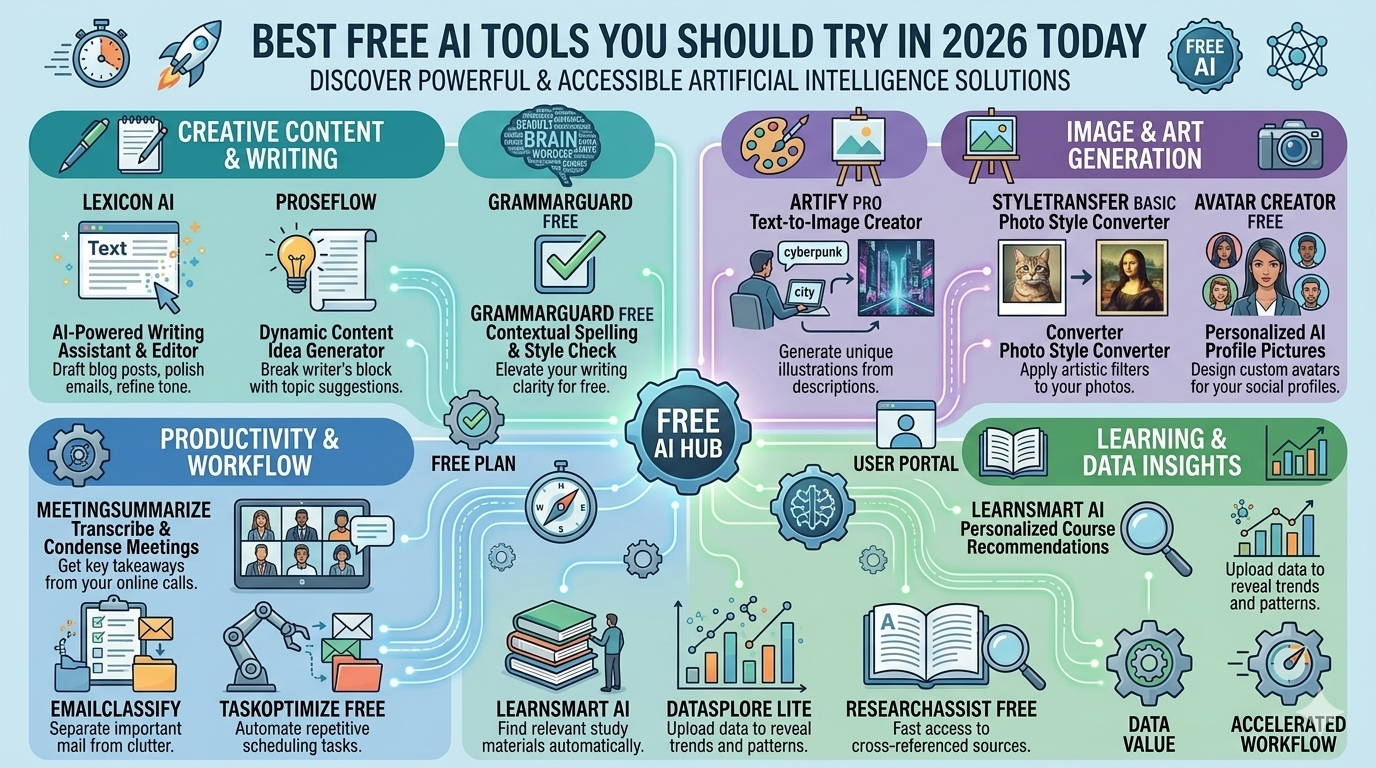
Artificial Intelligence has rapidly evolved into one of the most powerful technologies shaping daily life in 2026. What once required expensive software and specialized professionals can now be done with free AI tools available to anyone with an internet connection. From content creation and design to automation and data analysis, AI tools help individuals and businesses save time, reduce costs, and improve productivity.
This guide explores the best free AI tools you should try in 2026, the tasks they can handle, and how they are transforming industries. If you want a broader look at how these tools are changing work, start with our related guide to AI tools replacing repetitive human work in 2026.
The Growing Importance of Free AI Tools
AI is no longer limited to large corporations. Small businesses, students, freelancers, creators, and everyday users can now access AI-powered writing assistants, design generators, chatbots, analytics helpers, and productivity tools for free. These tools are useful because they reduce the barrier to entry. You can test an idea, create a draft, organize data, or automate a small task before investing in paid software.
Industries with complex operations, such as aviation, logistics, live events, sports, and customer support, increasingly rely on AI-powered systems for scheduling, forecasting, trend analysis, and audience engagement. Free versions of similar tools give individuals a practical way to learn the same workflows on a smaller scale.
AI Writing Tools for Content Creation
One of the most popular categories of free AI tools is content generation. AI writing tools can draft blog posts, social media captions, product descriptions, scripts, summaries, email replies, and SEO outlines in seconds. They are especially useful for bloggers, marketers, website owners, and small teams that need to scale content without hiring large teams.
- Create article outlines, introductions, FAQs, and meta descriptions.
- Rewrite rough drafts into clearer, more natural paragraphs.
- Generate social captions, video scripts, newsletter drafts, and ad copy.
- Speed up research while still requiring human fact-checking and editing.
AI Design and Image Generation Tools
Graphic design has traditionally required specialized skills, but AI has simplified many basic tasks. Free AI design tools can generate images, logos, posters, thumbnails, presentation graphics, and marketing materials from short prompts or templates.
These tools reduce the need for expensive design software when you only need quick concepts or simple visuals. They are ideal for social media posts, event promotions, personal branding, and early design drafts. A human designer is still valuable for polished brand systems, but AI can make the first version much faster.
AI Tools for Data Analysis and Predictions
AI is changing how data is analyzed and used for decision-making. Free AI tools can help users process spreadsheets, summarize datasets, identify patterns, create charts, and explain trends in plain language. Businesses, analysts, students, and sports enthusiasts can all benefit from faster insights.
- Summarize spreadsheet data and highlight important patterns.
- Generate simple charts, reports, and forecast explanations.
- Compare performance data in sports, sales, finance, or marketing.
- Turn complex information into easier summaries for presentations.
AI in Automation and Productivity
Automation is one of the biggest advantages of AI tools. Free AI platforms can automate repetitive tasks such as email responses, scheduling, meeting summaries, document organization, customer support replies, and workflow management.
These tools are especially useful for small businesses because they reduce manual coordination. For more examples of practical company use, read about AI business automation trends and real use cases.
AI in Entertainment and Media
The entertainment industry is experiencing a major transformation due to AI. From scriptwriting and video editing to subtitles and recommendations, AI tools streamline production and distribution. Streaming platforms also use AI to personalize recommendations and help users discover relevant content faster.
AI can generate summaries and reviews for books, shows, and films, making literature and media more accessible. It can also support creative storytelling by helping writers explore characters, plots, scenes, and alternate concepts quickly.
AI in Music and Pop Culture
Free AI music tools can help users compose background tracks, write lyrics, clean audio, generate voice effects, and test new creative styles. Musicians, podcasters, video creators, and marketers can use these tools to speed up production and experiment before moving into professional editing.
AI in Travel and Weather Forecasting
AI tools improve travel planning by providing real-time updates, weather predictions, route suggestions, price alerts, and personalized recommendations. Weather forecasting has become more accurate, helping travelers, logistics teams, and event planners make better decisions.
These tools can help users prepare for snow warnings, delays, busy travel periods, cultural events, and natural phenomena. The value is simple: better predictions reduce risk and save time.
AI in Sports and Performance Optimization
AI is widely used in sports to improve performance and strategy. Teams and analysts use AI tools to evaluate player performance, compare historical data, predict injury risks, and study tactics. Similar tools can help fans and sports writers understand matchups with more depth.
In motorsports, AI supports vehicle performance, race strategy, simulation, and safety analysis. In basketball, football, baseball, and combat sports, AI-driven analytics can reveal patterns that are difficult to see manually.
AI in Finance and Risk Management
AI tools are helping individuals and businesses manage finances more effectively. Free tools can support budgeting, expense tracking, fraud detection, investment research, market summaries, and risk analysis. They do not replace professional financial advice, but they can make financial information easier to understand.
Challenges and Limitations of AI Tools
Despite their advantages, AI tools are not perfect. Over-reliance on automation can reduce human involvement, creativity, and critical thinking. AI-generated content may also include inaccurate or misleading information, so users must verify outputs before publishing or making important decisions.
Privacy, bias, and ethical concerns also matter. Before using AI for sensitive work, it is worth understanding the key limitations, privacy risks, and accuracy problems in AI.
The Future of Free AI Tools
The future of free AI tools looks promising. As technology continues to evolve, AI will become more accessible, efficient, and powerful. These tools will not completely replace humans, but they will change how people work by making repetitive tasks faster and giving users more creative options.
How to Choose the Right AI Tools
With so many options available, choosing the right AI tools can be challenging. Start with your goal, test free versions, and focus on tools that save time without creating quality or privacy problems.
- Identify your needs, such as content creation, design, automation, research, or analysis.
- Start with free AI tools and explore their features before upgrading.
- Choose tools that are easy to use, reliable, and clear about data handling.
- Combine multiple tools for better results, such as writing, design, and SEO support.
- Review every AI output before publishing, sharing, or using it for decisions.
Free AI tools can be powerful when used with good judgment. The smartest approach is to treat them as assistants: let them speed up drafts, ideas, analysis, and workflows, while you provide the strategy, accuracy checks, and human creativity.